Verified Parent. For parents and legal guardians.
Did anyone check you're their parent?
When you set up family safety tools for your child, or ask a fintech to issue them a payment card, nobody checks that you're actually their parent or legal guardian. Anyone can say they are, which can result in harm and companies ignoring your authority to act on behalf of your child. Verified Parent is a campaign by parents and guardians who want platforms, AI companies and fintechs to protect children by design, and to answer to the families they serve.
I want to be a verified parent, able to act on behalf of my child.

01 / The gap
How it works today
When you set up an online family safety tool on your child's account, the apps usually walk you through something like this:
1
Your child sends an invitation or shows a code.
On some apps a teen sends a link or picks an adult's profile. On others, family pairing uses a QR code.
2
Whoever accepts is linked as the 'parent'.
The adult only has to accept or scan.
3
Nobody checks who that adult is.
It could be you. It could also be an older friend, or an adult your child met online who means them harm.
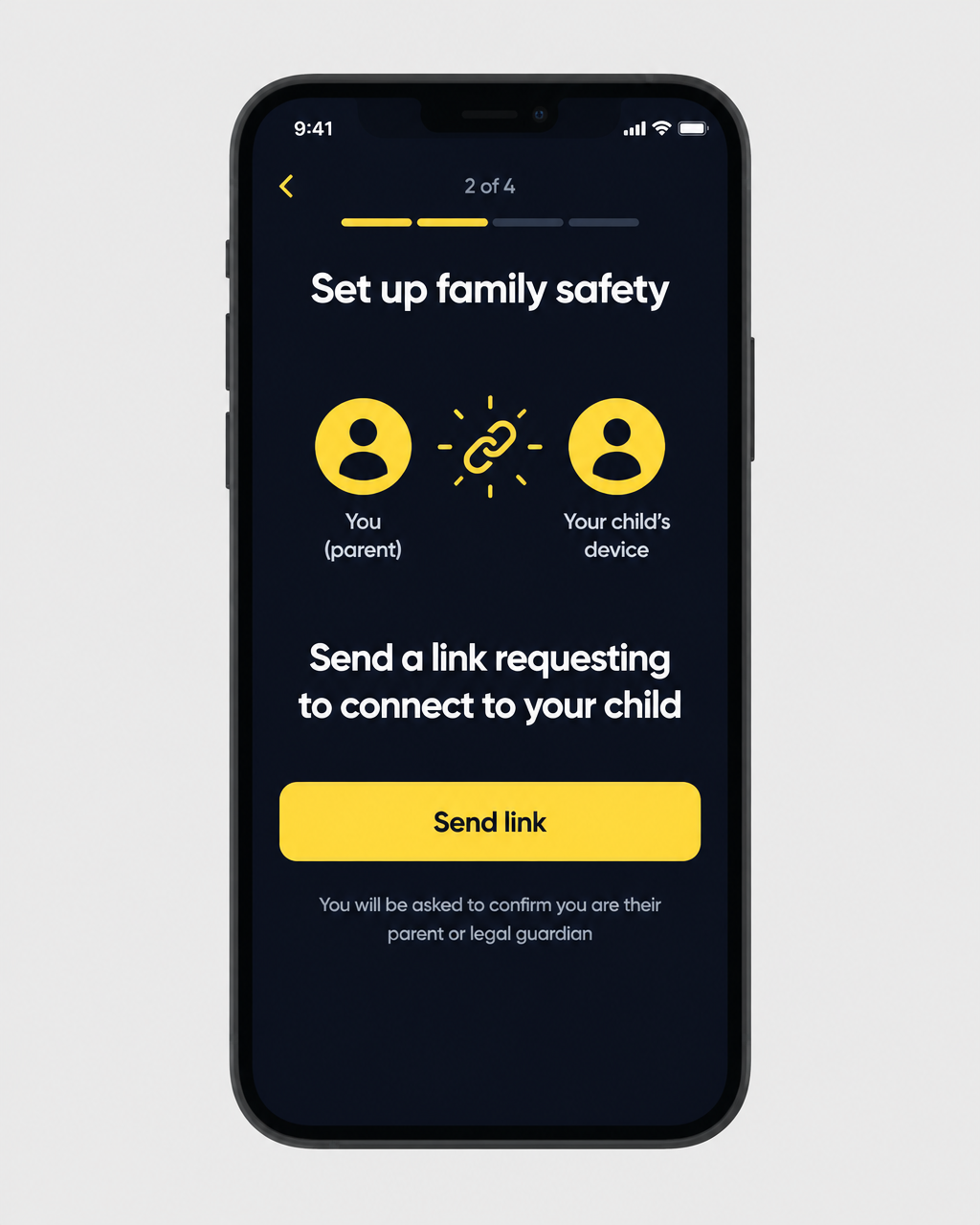
Illustrative image of a set-up screen in a generic online family safety tool. It is not a real app.
The same gap exists when a fintech issues a payment card to a 'child' through an adult's bank account. Nobody checks that the person is a parent, or that the 'child' is in fact a child, and the result is a proportion of cards used for fraudulent purposes.
The Financial Action Task Force, the international body that sets anti-money laundering standards, has documented how scam and fraud networks obtain and use accounts and cards like these: Illicit Financial Flows from Cyber-Enabled Fraud (2023) and Cyber-Enabled Fraud: Digitalisation and money laundering risks (2026). Browse further FATF reports on fraud methods and trends.
02 / The law
Why this matters
In many cases, the law already requires companies to get consent from the person who holds parental responsibility before processing a child's data. A new wave of online safety laws goes further. In Europe, Brazil and a growing number of US states, platforms are now expected or required to offer family safety tools, or to link a child's account to a parent or guardian, as part of safety by design.
Laws set the requirement. Global technical standards show how to meet it. The OpenID Foundation's delegated authority specification sets out how to verify that an adult holds parental responsibility, privately and against authoritative records. Work is also under way at the International Telecommunication Union to standardise how family safety tools work, so they are more protective and platforms' safety features can be audited.
What's missing is platforms putting these standards in place. Until they do, a safety tool can be turned against the child it is meant to protect, and the real parent or guardian is pushed aside.
"Safety tools are only as safe as the check on who controls them."
"In the US, prosecutors described how a trafficker used a family safety app to follow a 17-year-old's 'every move', calling it 'an electronic leash'. The app never checked who was controlling the child's account."
Source: Forbes: Sex Traffickers Used America's Favorite Family Safety App To Control Victims
03 / What's coming
AI is next
Children now talk to AI chatbots and companions, and AI agents are starting to act on people's behalf: searching, buying and sending messages. The same questions apply, with higher stakes. Is the child old enough for this service? Who agreed to it? And when an AI agent acts for a child or a parent, who gave it permission, and what is it allowed to do?
AI companies are starting to add family controls, often linked the same way as social media: by invitation, with no check that the adult is the child's parent or guardian. Regulators are paying attention. The US Federal Trade Commission has opened an inquiry into AI chatbots acting as companions, and the EU AI Act bans AI that exploits children's vulnerabilities because of their age.
The same standards apply. The OpenID Foundation's delegated authority specification was built with AI agents in mind, so an agent can prove who authorised it, for what, and within which limits.

Illustration. A conversation, and a check on who is behind it.
04 / The evidence
What families have shown
70%
of Irish 8 to 12-year-olds have accounts on apps meant for ages 13 and over.
~100
financial sextortion reports a day to the US National Center for Missing and Exploited Children in 2024.
126,000
people signed Jools' Law after Ellen Roome was told she needed a court order to see her late son's accounts.
If this raises difficult feelings, free and confidential support is available.
05 / Our asks
What needs to change
Safe by default
Safety settings are switched on from the start, so families aren't left to configure everything themselves.
Verified, not just claimed
Independent checks confirm the adult holds parental responsibility or legal guardianship, using privacy-preserving standards. Only a yes or no is shared. Platforms should not mark their own homework.
A receipt we can use
A tamper-evident record of when the platform knew a child's age and what safety settings it should enforce. See ‘A receipt for your child’s safety settings’ below.
It also helps platforms, AI companies and fintechs meet the rules they already face. Good for children, good for families, good for compliance.
06 / Privacy
Not surveillance
This is oversight of the platform, not of your teen. The only question being answered is whether a verified parent or legal guardian is connecting to that child and acting on the child's behalf. The platform only learns an age range and a yes or no. Nobody's documents or family circumstances are shared. The profiles a teen follows and the messages they send are not shown to parents unless the teen chooses to share them. Support and counselling services for young people stay open to them.
Verified means your legal relationship to your child is confirmed. Not judged, not rated, not tracked.
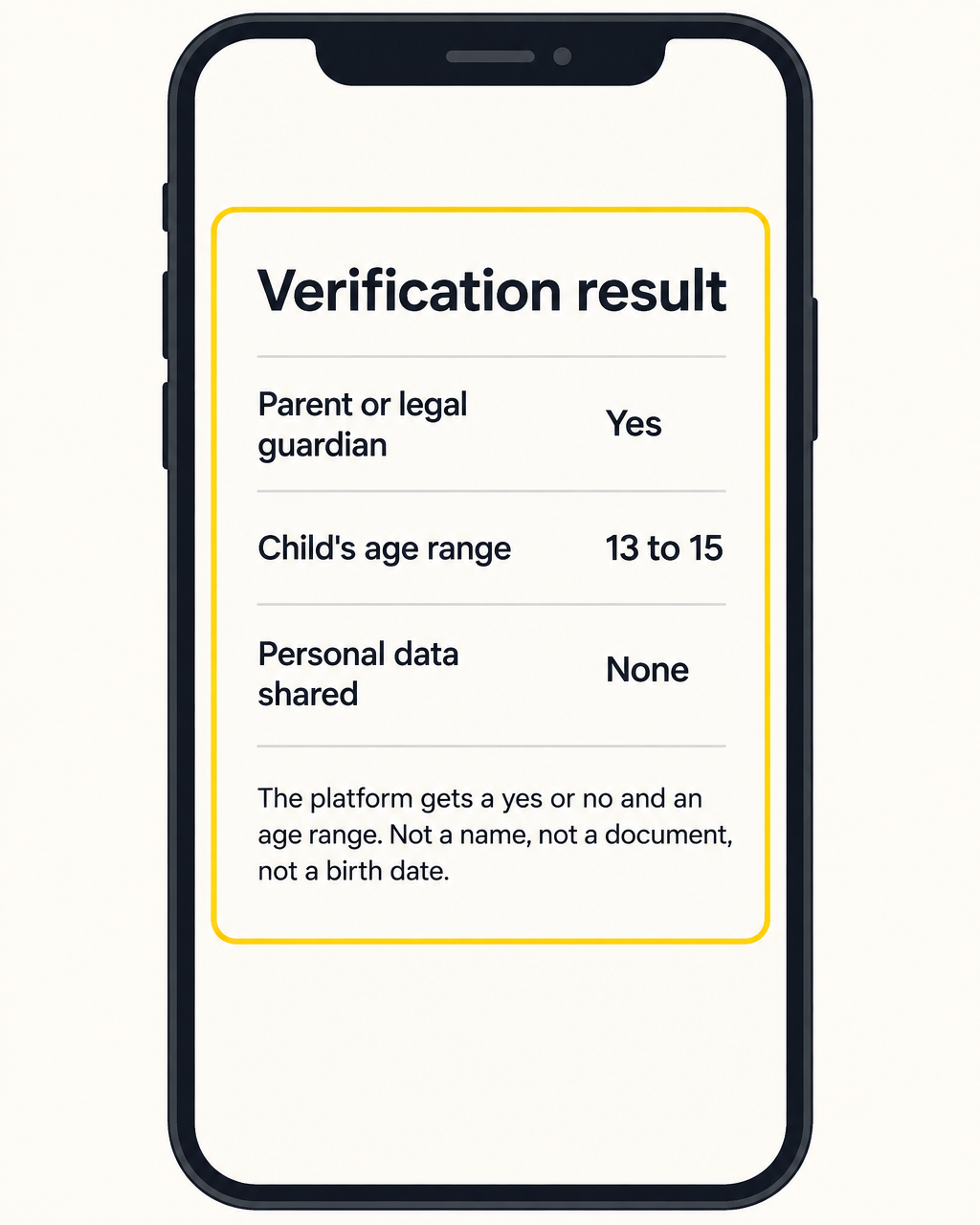
Illustrative screen of the result a platform receives. A yes or no, and an age range. No personal data is exchanged.
07 / Accountability
A receipt for your child's safety settings
When you buy something, you get a receipt. When you set up your child's safety settings, you should get one too.
We want every family to have a simple dashboard showing, with the date and time:
when your child's age was checked, and the result (an age range, never documents)
when your parental responsibility was verified
the safety settings the platform switched on by default
any changes you or your child made since
The record can't be changed without it showing, and it's shared between you and your teen. It never shows the profiles your teen follows or their messages.
It's your proof of what the platform was told and what it should have enforced.
If your child is shown harmful content, or contacted by adults the settings should have blocked, you can show exactly what the platform knew and when. No court order needed, and families can use their receipts together to hold platforms to account.
Safety settings receipt
Illustration
Age checked
14 Oct 2026 17:58
Result: age range 13 to 15
14 Oct 2026 17:58
Parental responsibility verified
14 Oct 2026 17:59
Default safety settings on
14 Oct 2026 18:00
- Chat with strangers: off
14 Oct 2026 18:00
- Recommendations: restricted
14 Oct 2026 18:00
- In-app purchases: off
14 Oct 2026 18:00
- Bedtime limit: 22:00 (you)
14 Oct 2026 18:02
- Bedtime limit: 21:30 (your teen)
14 Oct 2026 19:10
Shared with
You and your teen
Record reference
a9f2 7c31 04de b18c
Illustration. The dates, times and settings shown are examples, not a real record.
08 / Precedent
It's already done offline
Banks, doctors and public services already recognise parental responsibility. New international standards now make it possible to verify it online quickly and seamlessly, against authoritative records and in a privacy-preserving way.
09 / Collective action
Verified means we can act together
One parent is easy to ignore. Thousands of verified parents holding the receipts are not. Together, families can complain as one, ask what a platform knew and when, and hold it to its own promises.
When parents are verified and hold the receipts, platforms have every reason to keep children safe.
10 / FAQ
Questions people ask
Does this mean more work for parents?
+
Does this mean more work for parents?
+
Not more admin. Keeping children safe is largely the platform's job. The platform controls the content, the connections and the algorithms that decide what children see, so it has to build safety in from the start. A parent can't do that.
Safety settings should be on by default, whether or not a parent ever logs in. Parents and guardians still have a role: helping their children learn to act safely and responsibly online and, increasingly, checking that platforms are living up to safety by design. Being verified is what lets you do that. New international standards make the check quick and seamless: it runs against authoritative records in a privacy-preserving way, and the platform learns only a yes or no.
Will my teen lose their privacy?
+
Will my teen lose their privacy?
+
No. Parents are not shown the profiles a teen follows or their messages unless the teen chooses to share them. Support and counselling services for young people stay open to them.
Is this a digital ID for children?
+
Is this a digital ID for children?
+
No. Age assurance confirms whether someone is old enough, not who they are. The platform receives an age range and a yes or no, nothing more.
What if a parent is the danger?
+
What if a parent is the danger?
+
Today any adult can claim to be a parent, which makes things easier for anyone who means a child harm. Offline, when a parent is a risk, courts and child protection services can remove or restrict their parental responsibility. Checks against authoritative records should reflect those decisions, so a person who no longer holds parental responsibility, or is barred from acting on it, gets a “no” when they try to claim it online. The platform is never told why. Not every risk reaches a court, so there must also be a confidential route for a child or professional to raise concerns without alerting that adult. And a platform's safety protections should apply whether or not any parent is linked.
Does this include guardians, kinship carers and foster carers?
+
Does this include guardians, kinship carers and foster carers?
+
Yes. It covers anyone who holds parental responsibility or legal guardianship. A child's care status is never shared with platforms.
Who does the checking?
+
Who does the checking?
+
Independent providers working to open international standards: ISO/IEC 27566-1:2025 for age assurance, and the OpenID Foundation's delegated authority specification for parental responsibility. Not the platforms themselves.
Kids will just get round it.
+
Kids will just get round it.
+
Typed birthdays are easy to get round. Checks against authoritative records are not. No safety measure is perfect, and we do not abandon seatbelts because some people unbuckle them.
Age checks should be proportionate to risk.
+
Age checks should be proportionate to risk.
+
Agreed. Risk depends on features, not labels. A single-player game with no chat or purchases is lower risk. Chat with strangers, user-generated content, livestreaming or in-game payments expose children to the full spectrum of harms and call for highly effective age assurance and verified parental responsibility.
Family safety tools and app-store signals already solve this.
+
Family safety tools and app-store signals already solve this.
+
Tools that depend on parents switching settings on cannot replace safety by design. Operating-system and app-store age signals usually start from an age an adult types in, and none verifies parental responsibility. Without that check, a safety tool can be turned against the child it is meant to protect.
Why would platforms agree to this?
+
Why would platforms agree to this?
+
Because it rewards the ones that do the right thing. A verified parent and a clear record let platforms show they keep children safe by design, and help them comply with their age assurance, consent and child safety requirements. It also means families can hold to account the ones that don't.
11 / Transparency
Who is behind this
Verified Parent was started by Dr Rachel O'Connell, who has worked on children's online safety for more than 25 years. She is lead author of PAS 1296, a major contributor to the international age assurance standard ISO/IEC 27566, and co-author of the OpenID Foundation's delegated authority work.
Verified Parent is gathering the support of internet safety experts: practitioners, researchers and safeguarding leads who have spent their working lives on how children are harmed online. Those who have agreed to be named will be listed here as the list grows.
The standards this campaign supports are not one company's product. Experts from many companies, national standards bodies, research institutions and civil society organisations are developing them in the open, through bodies such as ISO and the OpenID Foundation, to provide the guardrails for a safer internet. Any provider can implement them.
In the interest of transparency: Rachel is also Founder and CEO of TrustElevate, one of the companies that provide verification services. The campaign does not endorse any provider, and the standards bodies named here are not responsible for the campaign.
Add your voice.
1 people have added their voice